
BIMTECH Business Perspectives

 Search

Jasveen Kaur1  and Sarita Arora2
1 University Business School (UBS), Guru Nanak Dev University, Amritsar, Punjab, India
2 Sri Aurobindo College of Commerce and Management, Ludhiana, Punjab, India

Creative Commons Non Commercial CC BY-NC: This article is distributed under the terms of the Creative Commons Attribution-NonCommercial 4.0 License (http://www.creativecommons.org/licenses/by-nc/4.0/) which permits non-Commercial use, reproduction and distribution of the work without further permission provided the original work is attributed.
The digital expansion and use of IOT have changed the dynamic of work culture. The traditional jobs are being replaced by flexible and temporary work arrangements. The purpose of this study is to explore the business model of platform-based gig economy and to study whether the gig economy promotes or restricts entrepreneurial activities. The present study is descriptive and explanatory in nature, based primarily on secondary data. This article is a review paper exploring the twin facets of the platform-based gig economy based on the research carried out in this regard. The business model of the platform-based gig economy has been studied, revealing that platforms, as intermediaries, consider gig workers to be self-employed, thereby claiming to foster entrepreneurial activities. However, some gig platforms regulate and control gig workers in a manner akin to that of employees. The type of job done on gig platforms decides if a worker is an employee or an entrepreneur. Platforms, gig workers, and end users can work together to strengthen their relationships, ensuring no adverse effects on either gig workers or platforms. Government authorities can also consider formalising these arrangements. This article is the authors’ original work and adds to the existing literature.
Technology-enabled gig economy, supporting and challenging entrepreneurial ventures entrepreneurship, gig platforms
Introduction
Work arrangements are becoming increasingly unstable, with independent contracting and temporary jobs becoming more common. A more flexible and dynamic type of work has replaced steady, lifetime employment during the last 50 years. Mobility, remote work, flexible schedules, and frequent job changes are commonplace in today’s industry (Griep et al., 2024). The rise of digital technologies has led to profound changes in employment dynamics, raising legal ambiguities concerning labour regulations in cyberspace (Cho & Cho, 2020). However, the impact is not limited to remote workers, as technological advancements are restructuring businesses, minimising reliance on conventional employees (Anwar, 2018). Digital transformation reached its pinnacle during the COVID era, revolutionising industries and redefining the way we work, connect, and innovate (Tomaševi.png) , 2023). Lockdown situation, which was never thought of even in dreams, was a reality in the year 2020 and can be there in future as well. Although this pandemic has brought several health hazards and economic collapse, leading to a disruptive economy but has also opened new roads for us. Every sector, be it industry, education, or technology, has learnt new ways to tackle the nasty consequences of COVID. During the lockdown, people showcased resilience by adapting and discovering new ways to engage in activities, preventing isolation from the outside world (Y
, 2023). Lockdown situation, which was never thought of even in dreams, was a reality in the year 2020 and can be there in future as well. Although this pandemic has brought several health hazards and economic collapse, leading to a disruptive economy but has also opened new roads for us. Every sector, be it industry, education, or technology, has learnt new ways to tackle the nasty consequences of COVID. During the lockdown, people showcased resilience by adapting and discovering new ways to engage in activities, preventing isolation from the outside world (Y.png) drm & Solmaz, 2022). Some started making vlogs and posting those on their respective YouTube channels, some were busy making Instagram reels, and some were utilising time for their neglected hobbies. Somehow, people have prepared themselves to fight against the effects. But on the other hand, it is also posing a financial burden on businesses and many households, leading to a dreadful economic recession (Gopinath, 2020; Pandey, 2020). The employed were being paid less than their actual salaries (Ghosh, 2020), and the self-employed were forced to use their past savings, thereby leading to a financial crunch for almost everyone. All these changes have given people time to think of the earning avenues being provided by the gig economy.
drm & Solmaz, 2022). Some started making vlogs and posting those on their respective YouTube channels, some were busy making Instagram reels, and some were utilising time for their neglected hobbies. Somehow, people have prepared themselves to fight against the effects. But on the other hand, it is also posing a financial burden on businesses and many households, leading to a dreadful economic recession (Gopinath, 2020; Pandey, 2020). The employed were being paid less than their actual salaries (Ghosh, 2020), and the self-employed were forced to use their past savings, thereby leading to a financial crunch for almost everyone. All these changes have given people time to think of the earning avenues being provided by the gig economy.
The advent of the pandemic and technological advancements accelerated the growth of the gig economy in developing countries like India. Independent work, flexibility (Manyika et al., 2016) and autonomy (Manyika et al., 2016; Shapiro, 2018) are the pillars of the gig economy, alluring many to be part of it. The temporary, casual, flexible and endless job opportunities being created by gig platforms led to the economic transformation where the participants enjoy their independence and freedom of working along with adequate earnings. The gig workers may undertake more than one job at a time, thereby augmenting their earnings (Sujoy, 2019). The independence and flexibility have made the gig a much-favoured platform for the youth, women and the retired persons. The job opportunities provided by gig are growing at an exponential pace. Heeks (2017) in his study concluded that more than 70 million of world’s population are got their job through the gig economy platforms. The global gig economy is rapidly growing, with a rising number of workers embracing it as their primary source of employment (Bates et al., 2021). In the future, gig workers and the gig economy will be a common phrase used in the business world. The growing gig economy is increasingly acknowledged as a driver for entrepreneurship, providing accessible chances for diverse populations to participate in revenue production and innovation (Raimi, 2025). The gig economy plays a fundamental role in promoting entrepreneurship by offering a flexible and accessible platform for individuals to explore and develop business ideas. It allows aspiring entrepreneurs to test their concepts with minimal financial risk, as they can earn income through gig work while refining their business models.
Need for the Study
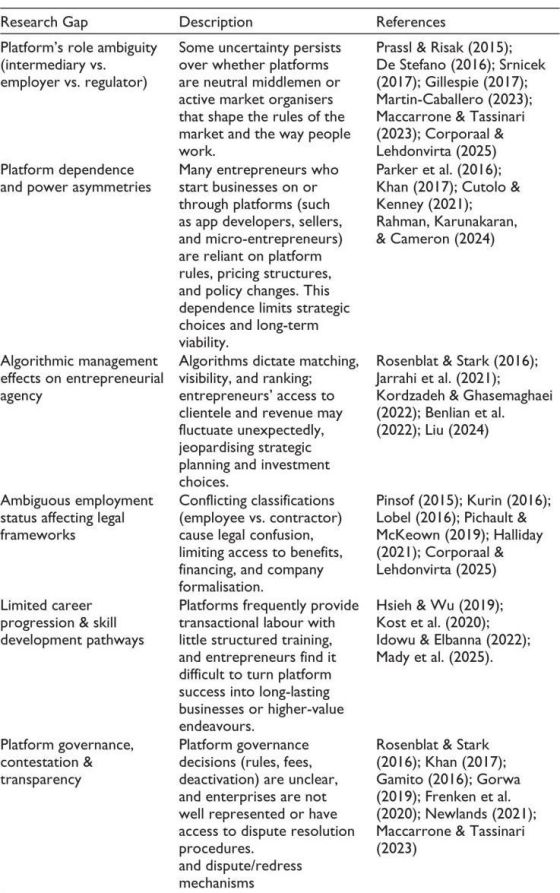
Despite its quick expansion and seeming possibilities for entrepreneurship, the gig economy poses difficult problems that are still poorly understood, thus posing an earnest desire for more in-depth academic research. Research has shown that entrepreneurs who use digital platforms are frequently very dependent on platform rules, fee structures, and legislative changes; nevertheless, the impact of this dependence on their strategic autonomy and long-term venture sustainability has not been sufficiently explored (Cutolo & Kenney, 2021; Parker et al., 2016; Rahman, Karunakaran, & Cameron, 2024). Limited evidence is available in academic literature showing how algorithmic management controls work distribution, visibility, and ratings and how these affect entrepreneurial decision-making, revenue stability, or development prospects (Benlian et al., 2022; Kordzadeh & Ghasemaghaei, 2022; Rosenblat & Stark, 2016; Jarrahi et al., 2021; Liu, 2024). Although precarity of income is still a defining feature of gig work, little is known about how it affects firm expansion and entrepreneurial investments (Hsieh & Wu, 2019; Kost et al., 2020; Idowu & Elbanna, 2022; Mady et al., 2025). Policy ambiguity over job classification, taxation, and social protection further constrains entrepreneurial changes; nevertheless, studies rarely examine the impact of such regulatory uncertainty on venture stability in developing economies (Corporaal & Lehdonvirta, 2025; Gillespie, 2017; Maccarrone & Tassinari, 2023; Martin, 2023; Prassl & Risak, 2015; De Stefano, 2016; Srnicek, 2017). These issues collectively emphasise that while the gig economy offers prospects for entrepreneurial expansion, the mechanisms by which platform architectures, governance frameworks, and technological elements facilitate or hinder entrepreneurship are still disjoint. This necessitates extensive research into the structural, technological, and regulatory factors influencing gig-based entrepreneurship, especially in emerging nations.
Different Facets of Gig Economy
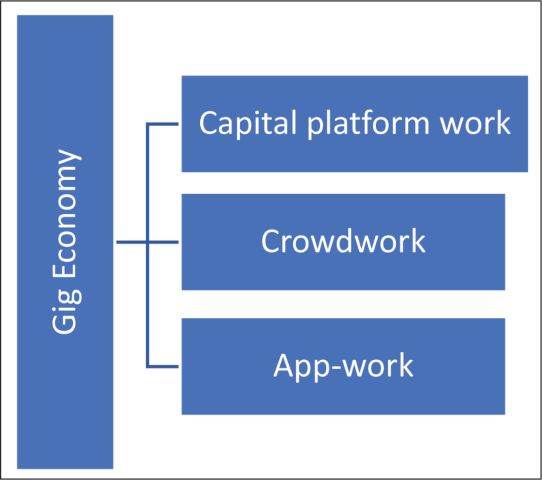
The work culture has undergone a major upheaval because of industrialisation and digitisation across the globe. It has tremendously transformed the landscape of employment and hiring labour of different skill sets. The independent contractor was approached to hire casual workers earlier, and now the same work is outsourced through digital platforms. The presence of digital platforms in connecting the demand and supply sides is the distinguishing feature of the gig economy. With easy access to the internet and smartphones, the employment levels have also been upgraded. The gig economy operates via three forms: capital platform work, crowdwork and app-work (Duggan et al., 2020).
Platform-based Work
The sellers use digital platforms to sell their products in this type of gig economy (Figure 1). The digital platforms are the intermediaries connecting the buyer and the seller in exchange for some financial gain (Duggan et al., 2020).
Figure 1. Forms of Gig Economy.
Source: Duggan et al. (2020).
Crowdwork
The technological innovations with augmented internet access led to the emergence of crowdwork—the digital labour platforms, thereby connecting the worker with the employer. These platforms provide access to workers of different skill sets performing clerical tasks to software development to web-based companies, facilitating flexibility and remote work (Berg, 2015).
App-work
The digital platforms mediate the service provider and the service recipient in exchange for commission (De Stefano, 2016; Duggan et al., 2020). The digital intermediaries create software or applications through which the service providers are connected to the service recipients. This form of gig work is very popular these days, and ride-hailing, food delivery, and accommodation services are being mediated through app-based digital platforms.
The common thread among these three different platforms is the digital intermediary, either connecting buyer with seller, worker with employer or service provider with service recipient. As these digital platforms are merely intermediaries, the gig workers are classified as independent workers or freelancers rather than employees. They are often categorised as self-employed, thus enhancing the entrepreneurial pursuits. The contradicting view is that platforms being the intermediaries regulate and control the gig workers, thereby making them mere employees, but with no specific labour regulation (Goods et al., 2019). The present study will be exploring the facts whether the gig economy operating via digital platforms promotes entrepreneurial activities or it is merely a myth that gig workers are not employees, but rather they are self-employed people.
Theoretical Background
Gig work is made possible by platforms’ digital networks, which are supported by matching technology and frequently employ algorithmic management (Rosenblat, 2018; Vallas & Schor, 2020) to exert varying degrees of control over performance and task distribution. Undoubtedly, gig work is a new form of non-standardised work, characterised by temporary contracts facilitated by intermediaries (Manyika et al., 2016).
Platforms frequently play an active role in forming economic landscapes and the social relations that exist within them, despite their self-presentation as passive middlemen between labour, end users, and other parties (Rosenblat, 2018). Thus, an attempt is made to review the existing literature to explore the business model used in the gig economy and how it is promoting entrepreneurial activities.
Business Model for Gig Economy
The extant literature suggests that there is no single business model that regulates gig work. The basic model is that the digital platforms act as an intermediary connecting the demand and supply sides (Donovan et al., 2016). But the actual business model depends upon the digital platform, the types of services they are providing as an intermediary, and their associated brands. Some platforms have control over the pricing decisions and kind of assignment to be offered, while others leave it to the choice of the service provider (Einav et al., 2016). Many gig companies operate on licensor-licensee relationships, thereby claiming exemption from providing employee benefits to gig workers (Kurin, 2016). Platform companies operating via apps connect the demand and the supply side, labelling gig workers as freelancers and independent contractors. Three party model is used in such companies where the intermediary is the central link between the customers and the service providers (Healy et al., 2017). This model offers immediate and flexible income opportunities for those who may not be considered for employment, including students, part-time workers, and individuals in transitional phases of their careers (Chappa et al., 2017).
The digital platforms facilitate a marketplace where skills and services can be exchanged efficiently, breaking down geographical barriers and opening up global opportunities. However, this transformation comes with challenges like ensuring fair compensation, job security, and access to benefits typically provided by traditional employment (Ahsan, 2020). The triangular relationship exists between the worker, the intermediary, and the end user. Intermediary, the digital platform has a contract with the worker regulating his pay, working conditions and also has control over the quality of services being rendered by the worker using these digital platforms. Second, these digital platforms establish contracts with end users that outline the terms of app usage, thereby limiting the liability of the digital platforms (Stewart & Stanford, 2017). Aldrich and Ruef (2006) identified that digital gigs can be categorised into four platforms dealing with crowdwork, transportation, delivery/home task, and online freelancing. The digital platforms in gig economy are somehow performing the staffing function by providing the appropriate workforce on a temporary basis by mediating the product and labour markets through the apps created by these digital intermediaries (Peck et al., 2005). The gig economy has largely operated through independent contractors and licensing agreements. Exploring a franchise model could provide gig companies with a strategic pathway to achieve scalability, standardisation, and stronger market presence. Currently, many gig economy platforms like Uber, TaskRabbit, etc., operate on a licensing or independent contractor basis, where individuals work under the platform’s brand and guidelines but maintain a high degree of autonomy over their work schedules and methods (Carnahan, 2016). In India, we also have Uber, driver in, Zomato, Swiggy, Blinkit, Urban Company and others operating on similar lines.
Gig Economy and Entrepreneurial Activities
Gig platforms empower individuals to monetise their skills, assets, and time by effectively connecting them with customers seeking these services. The presence of digital platforms as intermediaries created a term called independent workers, self-employed, freelancers, micro-entrepreneurs, gig workers and the like (Kuhn & Maleki, 2017). Jost (2011) established that if an employer hires a person having specialised, unique skills that the employer does not possess, such a hired one is called an independent contractor, whereas if the workers’ activities are controlled, then they are termed as an employee. The employer-employee relationship does not exist in the platform-based gig economy. Considering the case of Uber, the gig workers are classified as independent contractors, thereby paving the way for entrepreneurship. The Uber drivers are termed as entrepreneurs as the Uber company projects itself as an intermediary facilitating drivers to work more freely than commercial vehicle owners, thereby promoting entrepreneurial activities and uplifting the society (Edelman, 2017).
Unemployment and underemployment have become important factors affecting gig economy participation. Many people resort to gig work as a type of necessity-driven entrepreneurship since they have limited access to official, steady employment (Agrawal & Bellos, 2017). In the context of unstable job markets, gig platforms are a feasible choice for generating revenue because of their flexible nature and low entry hurdles, which enable people to monetise their time and abilities (Burtch et al., 2016). The study conducted by Mouazen and Hernández (2023). emphasised how women turned to gig work and entrepreneurship as adaptive survival strategies as a result of the COVID-19 pandemic and economic instability. It shows that women’s entrepreneurial endeavours are greatly aided by both the gig economy and the entrepreneurial ecosystem, with ecosystem components having a greater impact. As a result, the gig economy offers a different route to entrepreneurship as well as a coping strategy for financial difficulties. There are two viewpoints that suggest the gig economy platforms could encourage local entrepreneurship. First, these platforms free up ‘slack resources’ like time by offering flexible schedules and a steady income, enabling future business owners to pursue their ideas (Richner et al., 2014). Second, people can try out new prospects on the assurance of income from gig platforms, which promotes innovation and entrepreneurial exploration (Agrawal et al., 2015; Burtch et al., 2016; Greve, 2007).
Numerous operational and customer service requirements imposed by gig companies, such as using customer rankings to determine disciplinary actions and mandating the provision of on-demand services, have been interpreted by courts as evidence that the entrepreneur is, in fact, an employee rather than an independent contractor (Kurin, 2016). Limited research has concluded that digital gigs support entrepreneurial activities; however, a contradictory view exists, with some scholars considering gig workers as employees and advocating their recognition in official labour statistics (Manyika et al., 2016). The apps controlling the work allocation, price of the services rendered, and even controlling the performance of gig workers cannot entitle them as entrepreneurs; they are merely employees who are controlled by their virtual employer. Consequently, the demand for amending the labour laws to ensure the well-being and safety of the gig workers is rising (Wood et al., 2019). Gig workers usually operate under the terms set by the platforms, and these platforms manage many aspects of the transaction. This arrangement offers flexibility and immediate income opportunities but lacks the autonomy and long-term growth potential associated with traditional entrepreneurship. Some of the research indicates that gig workers are less likely to identify as entrepreneurs, reflecting the fundamental differences in their work and their roles within the economic landscape (Carnahan, 2016).
Whereas Rosenblat and Stark (2016) claimed that app-based platforms offer freedom to work and flexibility in accepting or rejecting work offers, thus entailing entrepreneurship (Table 1). This view is supported by Uber as they offer flexibility, freedom and autonomy to their drivers and assert that the drivers are the owners (Ahsan, 2020). In developing countries, the gig economy helps in empowering female entrepreneurs because of the flexibility of work (Mouazen & Hernández, 2023). By lowering the barriers to entry and offering a supportive environment, the gig economy encourages more people to pursue their entrepreneurial ambitions (Anwar & Graham, 2021).
Table 1. Research Gap.
Methodology
Based mostly on secondary sources, the study is descriptive in character. The methodology does not adhere to the established methods of a systematic review. Rather, it builds an integrative knowledge of how the gig economy affects entrepreneurial activity and outcomes by drawing on a wide range of research work. Depending on the topic’s scope, both descriptive and explanatory content are reviewed (Matthews & Ross, 2014). The research papers, reports and articles with the keywords like digital platforms, platform economy, gig economy, on-demand market, entrepreneurship, and entrepreneurial activities were searched from two of the popular search engines, namely Google Scholar and EBSCO. Eighty-seven research papers were reviewed with an aim to conduct a comprehensive study to explore the business model of gig economy and to explore the relationship between entrepreneurship and gig economy. The initial search identified 134 papers; 47 papers were dropped from the study after preliminary abstract screening, as they did not fit into the scope of the current paper. These papers were from the timeframe ranging from 2011 to 2025.
Research Questions
Globally, a new economic revolution is being ushered in by the gig economy’s explosive growth. According to the NITI Aayog report from 2021, by 2029–2030, the gig economy is predicted to employ 2.35 crore (23.5 million) people. This demonstrates how the gig economy would grow at an exponential rate. Therefore, the gig economy must have something unique to draw the attention of so many people. In addition to creating innumerable job possibilities, it can boost a nation’s GDP as well. This served as the impetus for carrying out research in this area. The following research questions need to be addressed:
RQ 1: To examine the core elements of the gig economy’s business model and evaluate their impact on its quick growth and changing labour standards.
RQ 2: To explore whether the gig economy creates meaningful opportunities for individuals to engage in entrepreneurial activities, or whether its structure places constraints on their entrepreneurial potential.
Observations and Discussion
Utilising technology-driven efficiencies is another crucial component bolstering the gig economy’s business model. Digital transformation is the foundation of the gig economy, where independent contractors are becoming more and more important participants. The capacity of digital platforms to link gig workers with a worldwide marketplace is a distinguishing characteristic of this business model. People can now make money from their abilities, time, or even underutilised assets, like a car, a house, or a specific service, rather than being constrained by geographical location or traditional organisational structures (Sundararajan, 2016; Tan et al., 2021).
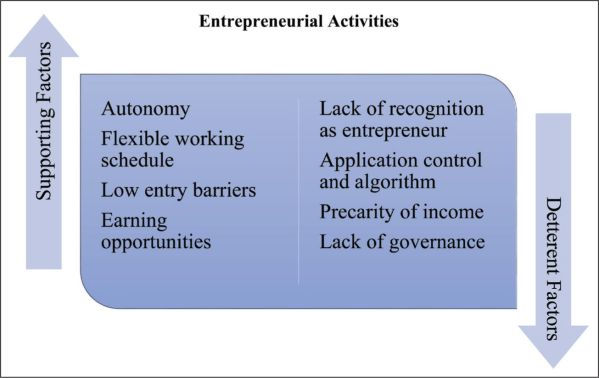
Digitalisation and job growth are fuelled by industries including tourism, social media, entertainment, retail, and demand for professional services. It is also important to note that the gig economy was born out of an entrepreneurial vision propelled by digitalised company models and platforms, in which freelancers and freelancing activities played a crucial part (Silva & Moreira, 2022). A wide range of services, including freelancing, transportation, home chores, cleaning, food delivery, and many others, are being provided through the gig platforms. These digital platforms create an application (app) or software which connects the work and the end user in exchange for some monetary gain. This is the homogenous model for any gig platform offering any kind of services (Aldrich & Ruef, 2006; Scheiber, 2017). These platforms use algorithms or software to match the demand and supply side through software, so these platforms cannot be termed as employers as they are not into direct selling or providing services; rather, they are a link between the producer or service provider and the customer. In this new landscape, individuals offer their labour through digital platforms that connect them directly with consumers and/or businesses in need of their services. These individuals are commonly referred to as ‘freelancers’ who work as per their own will and may be termed as entrepreneurs (Ahsan, 2020). The gig economy operates on three party model comprising the gig worker, the digital platform and the consumer. Gig workers and digital platforms do not have a conventional employer-employee relationship. In a similar vein, gig workers and consumers cannot be included in this paradigm. The gig economy’s ability to foster innovation by allowing people to participate in cutting-edge forms of entrepreneurship and work arrangements is a crucial factor contributing to its success (Donovan et al., 2016; Kumar & Aithal, 2024). The core of the model lies in algorithmic management, which regulates price, work distribution, and performance monitoring. Platforms can limit employees’ capacity to develop autonomous clientele by centralising customer acquisition and payment processing, thereby concentrating platform control (Cornelissen & Cholakova, 2021; Iancu, 2022; Singh & Kaunert, 2025). Rather, there is an unclear and changing interplay between customers, digital platforms, and gig workers (Lobel, 2016). The gig is operating mainly through four platforms, namely crowdwork platforms, online freelance platforms, transportation platforms, and delivery/home task platforms. The freelancers possessed certain skills, enjoy higher autonomy and can negotiate on pricing decisions, whereas gig workers engaged in crowdwork, transportation and delivery have relatively less autonomy and lower wages (Kalleberg & Dunn, 2016). Malin(2018) proclaimed that the platform’s relation with the gig workers is akin to a franchise model, wherein the franchisor (the platform) transfers the inherent business risks to the franchisee (the gig worker). With this plea, the platforms termed the gig workers as independent contractors, not employees. These independent contractors take platforms as a launchpad for their micro businesses as they use platforms’ client base to grow and expand their business (Pinsof, 2015). Hurst and Pugsley (2011) put forward a view that gig workers label themselves as their own boss as they enjoy the flexibility and autonomy in fixing the schedule and amount of work they prefer to do, as is done by a micro entrepreneur (Figure 2). A similar view is endorsed by Zervas et al. (2017) who concluded that gig workers uphold the characteristics of an entrepreneur rather than of an employee. Though they have little influence in the gig economy, freelancers are frequently seen as entrepreneurs because they are skilled gig workers (Cook, 2015). There are a few platforms that provide control to freelancers in gig economy in selecting their jobs, the working hours and the related aspects. Such workers can be correlated with entrepreneurs (Donovan et al., 2016). It is argued that platforms grant the phony term of independent contractors so as to avoid legal requirements for various labour laws. The platforms, by controlling the performance and pricing decisions, are actually treating gig workers as employees and, on the same hand, they mask them as entrepreneurs (Bornstein, 2015). Even Kurin (2016) revealed that despite several arguments, some sort of employment relationship prevails and regulates the gig economy. This relationship cannot be purely termed as employer-employee, but the platforms cannot deny their responsibility towards gig workers. The gig workers are working with distinctive motives and view the gig platform as the primary source of their income, or just to supplement their existing income base, and may find it challenging to improve the working conditions (Manyika et al., 2016). It is the kind of job that is being performed via gig platforms that determines whether the gig worker can be termed as an employee or an entrepreneur. The gig economy has less of an impact on the entrepreneurial ecosystem, notwithstanding its beneficial effects. It supports those operating unproductive enterprises and acts as a safety net for prospective business owners. The digital platforms offer accessible and adaptable ways to generate income, especially for vulnerable populations. The results are in congruence, showing how gig work and ecosystem support and complement each other in promoting women’s entrepreneurship in developing nations (Mouazen & Hernández, 2023). Another aspect that emerges from extant literature is that because of the flexibility and scheduling of their activities, people can pursue other entrepreneurial ventures with some certainty of income from gig platforms. They have surplus time and resources to invest in entrepreneurial activities (Burtch et al., 2016; Richner et al., 2014). A study on gig micro-entrepreneurs revealed that short-term contracts increasingly serve as a type of entrepreneurial agency, assisting people in maintaining their social and financial livelihoods (Peterson & Crittenden, 2024). In this way, it can be concluded that gig platforms promote as well, but sometimes these do not uphold entrepreneurial activities.
Figure 2. Factors Promoting and Restricting Entrepreneurial Activities.
Implications
Theoretical Implications
The gig economy’s reliance on digital platforms and technology has revolutionised how individuals engage in work, offering flexibility and autonomy but also raising significant questions about labour rights and job security. Examining these dynamics involves assessing how gig platforms disrupt traditional employment structures, often classifying workers as independent contractors rather than employees, thereby affecting access to benefits and legal protections. Gig economy is flourishing at an exponential pace, thereby contributing to the development of the economy. It has the capacity to generate millions of jobs (Standing, 2016). By expanding our knowledge of the relationship between participation in the gig and sharing economies and entrepreneurial intention, this study makes numerous significant theoretical advances. This is an upcoming area of research for many. The current paper will be a contribution to the existing literature base. The current paper contributes to the existing literature by addressing the ambiguous relationship between gig workers and the platforms they engage with. This research highlights the complexities and dynamics of this relationship, encouraging scholars to delve deeper into the subject. The findings could pave the way for the development of new theoretical frameworks, enriching our understanding of labour markets in the digital age. It suggests that platform-mediated workplaces could function as early-stage entrepreneurial learning environments where people acquire exposure, confidence, and low-risk experience that influence their future entrepreneurial decisions. The current paper proposes that gig participation is not just a labour market alternative but rather is embedded within broader entrepreneurial trajectories shaped by past experience and social networks. The study reinforces theoretical connections between entrepreneurial ecosystems and platform-based labour markets.
Managerial Implications
The platforms, the gig workers and the end users can work together to strengthen their relationship so that neither the workers nor the platforms face any detrimental impact. Government authorities might bring more structural changes for the gig workers by introducing laws that protect them. Recognising them as either workers or entrepreneurs, policymakers can ensure that their rights and well-being are not overlooked. The platform owners can also consider this research and develop a business model that focuses on profitability but without compromising the well-being of gig workers. Platforms can devise certain mentorship or training for gig workers to enhance their ability to work and earn more. The research indicates that people are inclined to gig platforms mainly because of ample opportunities, so the platforms can give a clear message indicating the benefits to emphasise how gig work can be a source of income and a launching pad for future entrepreneurs. Entrepreneurship agencies may acknowledge gig workers as an expanding pool of potential entrepreneurs and may arrange focused entrepreneurial programmes or micro-venture support for the gig workers. Additionally, policymakers ought to think about developing frameworks that facilitate gig workers’ transition into long-term business endeavours. Policymakers or the government might guarantee that gig workers receive fair treatment and social rights while yet allowing platforms to develop and grow. The policies should also look into ways to both protect and promote gig work.
Conclusion
Gig economy is usually considered a platform for supplementing earnings, but it also upholds entrepreneurial pursuits. Broadening the meaning of entrepreneurship from making or inventing a new product to having charge of one’s own resources, time, money and one’s own skills. Gig economy makes gig workers their own bosses while learning business principles by exploring flexibility and resourcefulness while earning a good amount of money for their livelihood. Features like flexible time, low entry barriers, no age bars, and low educational background made the gig economy very promising for the developing nations, where unemployment levels are usually high (Manyika et al., 2016). Gig economy is flourishing and creating millions of job opportunities and also fostering entrepreneurship in platforms requiring specialised and skilled services, and the platforms regulating gig workers are not truly promoting entrepreneurial activities, but rather providing flexibility and partial autonomy. However, while these platforms are instrumental in providing flexibility and partial autonomy, they do not fully promote entrepreneurial activities in the traditional sense. Instead of enabling gig workers to build and scale independent businesses, many platforms regulate the terms of engagement, limiting the potential for true entrepreneurial freedom. This regulatory environment often restricts gig workers’ ability to fully control their work conditions, pricing, and client relationships. Consequently, while the gig economy opens doors to new forms of work and income generation, it also imposes constraints that prevent gig workers from realising the full spectrum of entrepreneurial opportunities.
Future Research and Limitations
The major research is carried out keeping in mind the business model of app-based digital platforms. It cannot be generalised based on a single forum of gig platforms to conclude whether the gig workers are employees or entrepreneurs. The untapped zones of the veiled employment relationship need to be explored further so that the state of gig workers can be improved. Undoubtedly, gig has the potential to create millions of job avenues on the one hand, and it should also ensure the decent state of its participants as well. Future research and policy interventions should address these limitations to better support the entrepreneurial aspirations of gig workers. The ride-hailing platforms like Uber have been researched so far in this regard; other platforms, like offering transportation, home services or delivery platforms, need to be examined to check whether they are promoting or repressing entrepreneurship.
Declaration of Conflicting Interests
The authors declared no potential conflicts of interest with respect to the research, authorship and/or publication of this article.
Funding
The authors received no financial support for the research, authorship and/or publication of this article.
ORCID iDs
Jasveen Kaur https://orcid.org/0000-0001-6793-1000
Sarita Arora https://orcid.org/0000-0002-3986-3706
Agrawal, A., Catalini, C., & Goldfarb, A. (2015). Slack time and innovation [Working Paper No. 21134]. National Bureau of Economic Research.
Agrawal, V. V., & Bellos, I. (2017). The potential of servicizing as a green business model. Management Science, 63(5), 1545–1562.
Ahsan, M. (2020). Entrepreneurship and ethics in the sharing economy: A critical perspective. Journal of Business Ethics, 161(1), 19–33.
Aldrich, H. E., & Ruef, M. (2006). Organizations evolving (2nd ed.). Sage Publications.
Anwar, M. A., & Graham, M. (2021). Between a rock and a hard place: Freedom, flexibility, precarity and vulnerability in the gig economy in Africa. Competition & Change, 25(2), 237–258.
Anwar, S. T. (2018). Growing global in the sharing economy: Lessons from Uber and Airbnb. Global Business and Organizational Excellence, 37(6), 59–68.
Bates, O., Lord, C., Alter, H., Friday, A., & Kirman, B. (2021). Lessons from one future of work: Opportunities to flip the gig economy. IEEE Pervasive Computing, 20(4), 26–34.
Benlian, A., Wiener, M., Cram, W. A., Krasnova, H., Maedche, A., Möhlmann, M., Recker, J., & Remus, U. (2022). Algorithmic management: Bright and dark sides, practical implications, and research opportunities. Business & Information Systems Engineering, 64(6), 825–839.
Berg, J. (2015). Income security in the on-demand economy: Findings and policy lessons from a survey of crowdworkers. Comparative Labor Law & Policy Journal, 37, 543–576.
Bornstein, J. (2015, October 25). The great Uber fairness fallacy: As a driver, how do you bargain with an app? The Guardian. https://www.theguardian.com/technology/2015/aug/24/uber-fairness-independent-contractors-employees-rights
Burtch, G., Carnahan, S., & Greenwood, B. N. (2016). Can you gig it? An empirical examination of the gig-economy and entrepreneurship. In Academy of Management Proceedings (Vol. 2016, No. 1, p. 14466). Academy of Management. https://pubsonline.informs.org/doi/10.1287/mnsc.2017.2916
Burtch, G., Carnahan, S., & Greenwood, B. N. (2018). Can you gig it? An empirical examination of the gig economy and entrepreneurial activity. Management science, 64(12), 5497–5520.
Carnahan, S. (2016). Can you gig it? An empirical examination of the gig-economy and entrepreneurial activity.
Chappa, C., Varghese, M., & Chandler, K. (2017). Shaping the gig economy. In Proceedings of the Northeast Business & Economics Association (pp. 70–73). https://digitalcommons.molloy.edu/cgi/viewcontent.cgi?params=/context/bus_fac/article/1028/&path_info=NBEA_2017_Conference_Proceeding_Shaping_the_Gig_Economy.pdf
Cho, W., & Cho, S. E. (2020). Entrepreneurial challenges in business model for the gig economy: Agendas for research and business development. International Journal of Entrepreneurship, 24(1), 1–11.
Cook, N. (2015, October 25). The insecure world of freelancing. The Atlantic. https://www.theatlantic.com/business/archive/2015/07/building-social-safety-net-freelancers/399551/
Cornelissen, J., & Cholakova, M. (2021). Profits Uber everything? The gig economy and the morality of category work. Strategic Organization, 19(4), 722–731.
Corporaal, G. F., & Lehdonvirta, V. (2025). Resolving disputes in mediated ‘gig’ work: How marketplace structure influences the impartiality of dispute handling by labor market intermediaries. New Technology, Work and Employment, 40(2), 285–308.
Cutolo, D., & Kenney, M. (2021). Platform-dependent entrepreneurs: Power asymmetries, risks, and strategies in the platform economy. Academy of Management Perspectives, 35(4), 584–605.
De Stefano, V. (2016). The rise of the ‘just-in-time workforce’: On demand work, crowdwork, and labor protection in the ‘gig-economy’ [Working Paper No. 71]. Conditions of Work and Employment Series. International Labour Organization.
Donovan, S. A., Bradley, D. H., & Shimabukuru, J. O. (2016). What does the gig economy mean for workers? chrome-extension://efaidnbmnnnibpcajpcglclefindmkaj/https://ecommons.cornell.edu/server/api/core/bitstreams/c768a7f6-106f-4c14-9a4f-822267dc3d78/content
Duggan, J., Sherman, U., Carbery, R., & McDonnell, A. (2020). Algorithmic management and app-work in the gig economy: A research agenda for employment relations and HRM. Human Resource Management Journal, 30(1), 114–132.
Edelman, B. (2017). Uber can’t be fixed—It’s time for regulators to shut it down. Harvard Business Review. https://hbr.org/2017/06/uber-cant-be-fixed-its-time-for-regulators-to-shut-it-down
Einav, L., Farronato, C., & Levin, J. (2016). Peer-to-peer markets. Annual Review of Economics, 8, 615–635.
Ghosh, J. (2020). A critique of the Indian government’s response to the COVID-19 pandemic. Journal of Industrial and Business Economics, 47(3), 519–530.
Gillespie, T. (2017). Platforms are not intermediaries. Georgetown Law Technology Review, 2, 198–216.
Goods, C., Veen, A., & Barratt, T. (2019). ‘Is your gig any good?’ Analysing job quality in the Australian platform-based food-delivery sector. Journal of Industrial Relations, 61(4), 502–527.
Gopinath, G. (2020, April 14). The great lockdown: Worst economic downturn since the Great Depression. IMF Blog. https://www.newsofbahrain.com/epaper/15-04-2020/single/page-06.pdf
Greve, H. R. (2007). Exploration and exploitation in product innovation. Industrial and Corporate Change, 16(5), 945–975.
Griep, Y., Hansen, S. D., Kraak, J. M., Sherman, U., & Bankins, S. (2024). Sustainable human resource management: The good, the bad, and making it work. Organizational Dynamics, Article 101112.
Halliday, D. (2021). On the (mis)classification of paid labor: When should gig workers have employee status? Politics, Philosophy & Economics, 20(3), 229–250.
Healy, J., Nicholson, D., & Pekarek, A. (2017). Should we take the gig economy seriously? Labour & Industry: A Journal of the Social and Economic Relations of Work, 27(3), 232–248.
Heeks, R. (2017). Decent work and the digital gig economy: A developing country perspective on employment impacts and standards in online outsourcing, crowdwork, etc. Development Informatics Working Paper, (71). https://doi.org/10.2139/ssrn.3431033
Hurst, E., & Pugsley, B. W. (2011). What do small businesses do? Brookings Papers on Economic Activity, 2, 73–142.
Iancu, A. L. (2022). Sustainable management in the gig economy: Traditional vs. gig business model in the delivery sector. In Proceedings of the International Management Conference (Vol. 16, No. 1, pp. 173–185). Faculty of Management, Academy of Economic Studies, Bucharest, Romania.
Jarrahi, M. H., Newlands, G., Lee, M. K., Wolf, C. T., Kinder, E., & Sutherland, W. (2021). Algorithmic management in a work context. Big Data & Society, 8(2), 20539517211020332.
Jost, M. P. S. (2011). Independent contractors, employees and entrepreneurialism under the National Labor Relations Act: A worker-by-worker approach. Washington & Lee Law Review, 68, 311.
Kalleberg, A. L., & Dunn, M. (2016). Good jobs, bad jobs in the gig economy. LERA for Libraries, 20(1–2), 10–13.
Khan, L. M. (2017). Sources of tech platform power. Georgetown Law Technology Review, 2, 325.
Kordzadeh, N., & Ghasemaghaei, M. (2022). Algorithmic bias: Review, synthesis, and future research directions. European Journal of Information Systems, 31(3), 388–409.
Kuhn, K. M., & Maleki, A. (2017). Micro-entrepreneurs, dependent contractors, and instaserfs: Understanding online labor platform workforces. Academy of Management Perspectives, 31(3), 183–200.
Kurin, J. (2016). A third way for applying US labor laws to the online gig economy: Using the franchise business model to regulate gig workers. Journal of Business & Technology Law, 12, 193.
Lobel, O. (2016). The law of the platform. Minnesota Law Review, 101, 87.
Malin, M. H. (2018). Protecting platform workers in the gig economy: Look to the FTC. Indiana Law Review, 51, 377.
Manyika, J., Lund, S., Bughin, J., Robinson, K., Mischke, J., & Mahajan, D. (2016). Independent work: Choice, necessity, and the gig economy. McKinsey Global Institute.
Martin-Caballero, A. (2023). Understanding conflict over regulation of platform work: A critical literature review on the role of institutions, networks and frames in policy-making. Relations Industrielles/Industrial Relations, 78(4). https://doi.org/10.7202/1111506ar
Matthews, B., & Ross, L. (2014). Research methods: A practical guide for the social sciences. Pearson.
Mouazen, A. M., & Hernández-Lara, A. B. (2023). Entrepreneurial ecosystem, gig economy practices and women’s entrepreneurship: The case of Lebanon. International Journal of Gender and Entrepreneurship, 15(3), 249–274.
Pandey, R. (2020). COVID-19 and MSMEs: The identification problem. Ideas for India. Retrieved, 12 February 2026, from https://www.ideasforindia.in/topics/macroeconomics/covid-19-and-the-msme-sector-the-identification-problem.html
Peck, J., Theodore, N., & Ward, K. (2005). Constructing markets for temporary labour: Employment liberalization and the internationalization of the staffing industry. Global Networks, 5(1), 3–26.
Peterson, R. A., & Crittenden, V. (2024). Microentrepreneurs in the gig economy: who they are, what they do, and why they do it. Journal of Research in Marketing and Entrepreneurship, 26(4), 565–587.
Pichault, F., & McKeown, T. (2019). Autonomy at work in the gig economy: Analysing work status, work content and working conditions of independent professionals. New Technology, Work and Employment, 34(1), 59–72.
Pinsof, J. (2015). A new take on an old problem: Employee misclassification in the modern gig-economy. Michigan Telecommunications & Technology Law Review, 22, 341.
Prassl, J., & Risak, M. (2015). Uber, TaskRabbit, and Co.: Platforms as employers—Rethinking the legal analysis of crowdwork. Comparative Labor Law & Policy Journal, 37, 619.
Rahman, H. A., Karunakaran, A., & Cameron, L. D. (2024). Taming platform power: Taking accountability into account in the management of platforms. Academy of Management Annals, 18(1), 251–294.
Richner, A., Ahlstrom, P., & Goffin, K. (2014). ‘Squeezing R&D’: A study of organizational slack and knowledge creation in NPD, using the SECI model. Journal of Product Innovation Management, 31(6), 1268–1290.
Rosenblat, A. (2018). Uberland: How algorithms are rewriting the rules of work. Univ of California Press.
Rosenblat, A., & Stark, L. (2016). Algorithmic labor and information asymmetries: A case study of Uber’s drivers. SSRN Electronic Journal. https://doi.org/10.2139/ssrn.2686227
Scheiber, N. (2017, April 2). How Uber uses psychological tricks to push its drivers’ buttons. The New York Times.
Shapiro, A. (2018). Between autonomy and control: Strategies of arbitrage in the ‘on-demand’ economy. New Media & Society, 20(8), 2954–2971.
Silva, B. C., & Moreira, A. C. (2022). Entrepreneurship and the gig economy: A bibliometric analysis. https://www.proquest.com/docview/2678859427?pq-origsite=gscholar&fromopenview=true&sourcetype=Scholarly%20Journals” Entrepreneurship and the gig economy: A bibliometric analysis - ProQuest
Singh, B., & Kaunert, C. (2025). Innovative business models in digital and virtual reality for the gig economy: Space-age sustainable development projecting smart business practices. In Business transformation in the era of digital disruption (pp. 127–156). IGI Global Scientific Publishing.
Srnicek, N. (2017). The challenges of platform capitalism: Understanding the logic of a new business model. Juncture, 23(4), 254–257.
Standing, G. (2016). The corruption of capitalism: Why rentiers thrive and work does not pay. Biteback Publishing.
Stewart, A., & Stanford, J. (2017). Regulating work in the gig economy: What are the options? The Economic and Labour Relations Review, 28(3), 420–437.
Sujoy, B. (2019, September). Bringing commitment in gig worker would be a challenge. Business Manager. Retrieved, 12 February 2026, from https://www.businessmanager.in/bringing-commitment-in-gig-worker-would-be-a-challenge.php.
Tomaševi, A. N. (2023). Reshaping the future of work: Navigating the impacts of lifelong learning and digital competences in the era of 5.0 industry. Social Informatics Journal, 2(1), 1–6.
Vallas, S., & Schor, J. B. (2020). What do platforms do? Understanding the gig economy. Annual Review of Sociology, 46(1), 273–294.
Wood, A., Graham, M., & Lehdonvirta, V. (2019). Networked but commodified: The (dis)embeddedness of digital labour in the gig economy. Sociology. Advance online publication. https://doi.org/10.1177/0038038519828906.
Yldrm, M., & Solmaz, F. (2022). COVID-19 burnout, COVID-19 stress and resilience: Initial psychometric properties of COVID-19 Burnout Scale. Death Studies, 46(3), 524–532.
Zervas, G., Proserpio, D., & Byers, J. W. (2017). The rise of the sharing economy: Estimating the impact of Airbnb on the hotel industry. Journal of Marketing Research, 54, 687–705.
